Justworks R&D Tax Credits
Increasing the amount of eligible customers claiming the R&D tax credit while streamlining the claims process.
Strategic challenge
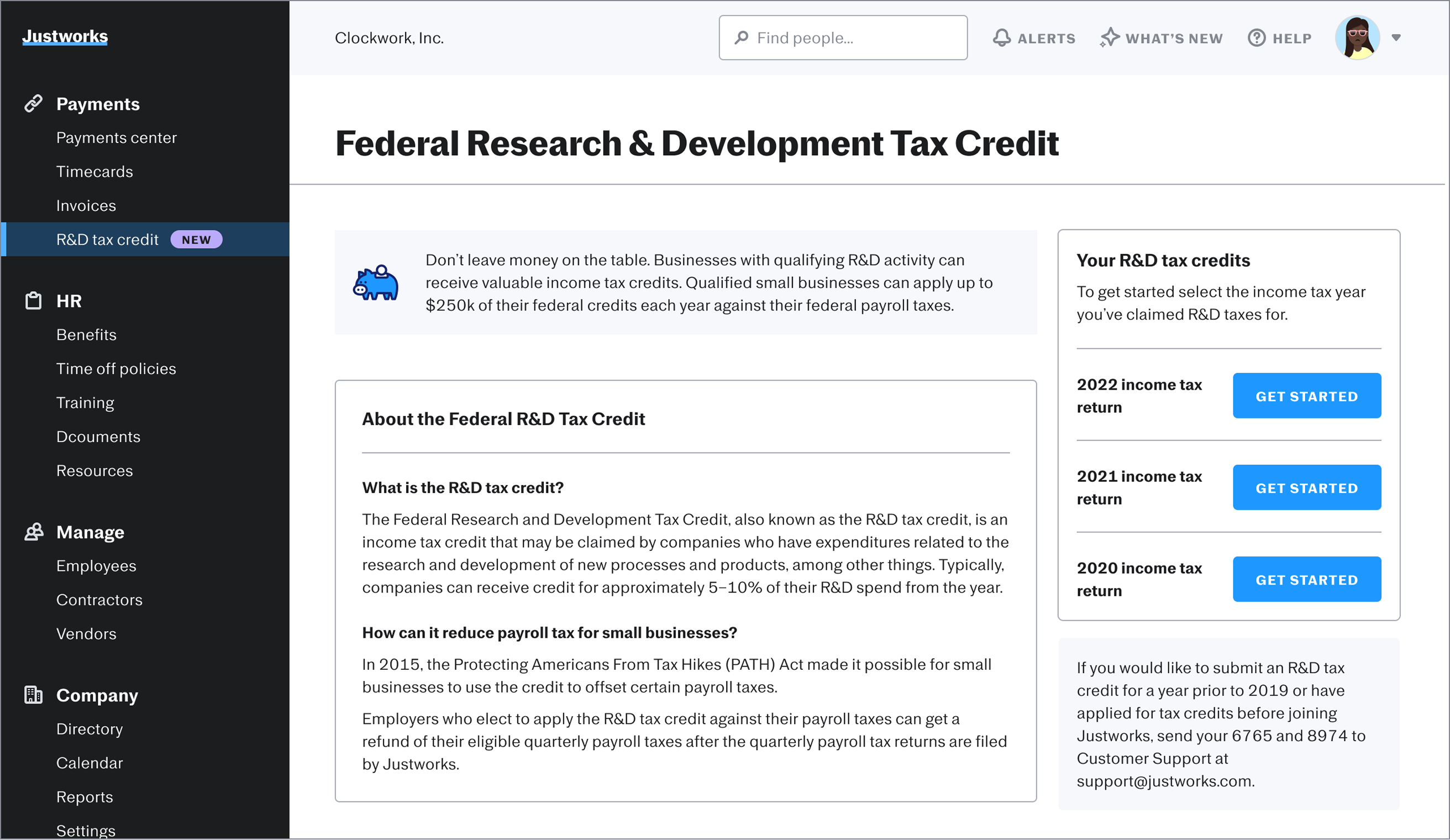
The Federal Research and Development (R&D) Tax Credit is an income tax credit that may be claimed by companies who have expenditures related to the research and development of new processes and products, among other things. To be eligible to claim the credit, companies must meet a series of tests determined by the Internal Revenue Service (IRS).
In 2015, the Protecting Americans From Tax Hikes (PATH) Act was passed, making R&D credits more accessible to small businesses.
Justworks saw a 9,675% increase in customers submitting R&D claims between 2016 and 2021. The team needed a scalable way to educate customers, collect required information, and review submissions without relying on a manual back-and-forth between customers and Customer Success. I was tasked with architecting the zero-to-one digital product for this service—transforming an unstructured, offline process into a centralized, secure self-service portal that ensured data integrity and drastically reduced processing timelines
The current state
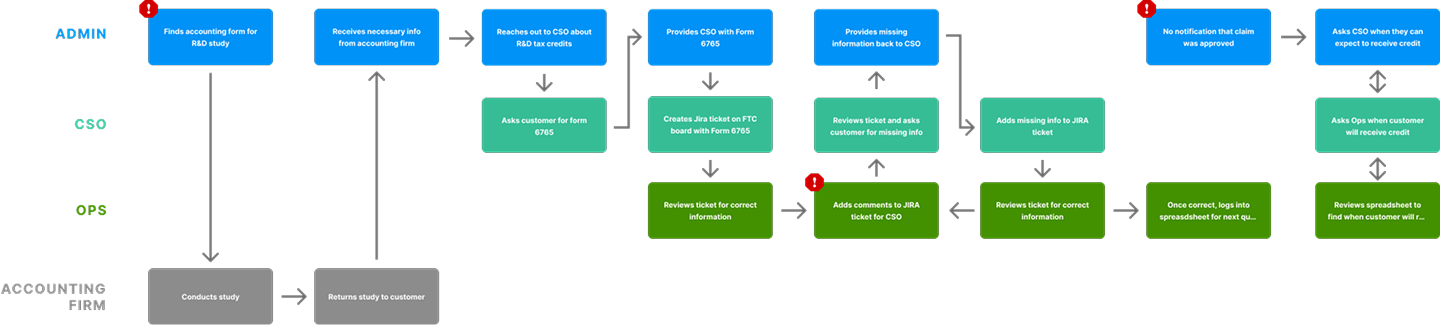
19 steps, 4 service layers
The R&D Tax Credit process relied on a highly manual, high-friction email workflow to collect and verify customer documentation. This created massive process inefficiencies for our internal teams and lacked tracking visibility for customers. There was no opportunity in app to discover what R&D tax credit services Justworks’ provides.
R&D tax credits: coming soon! (2 weeks)
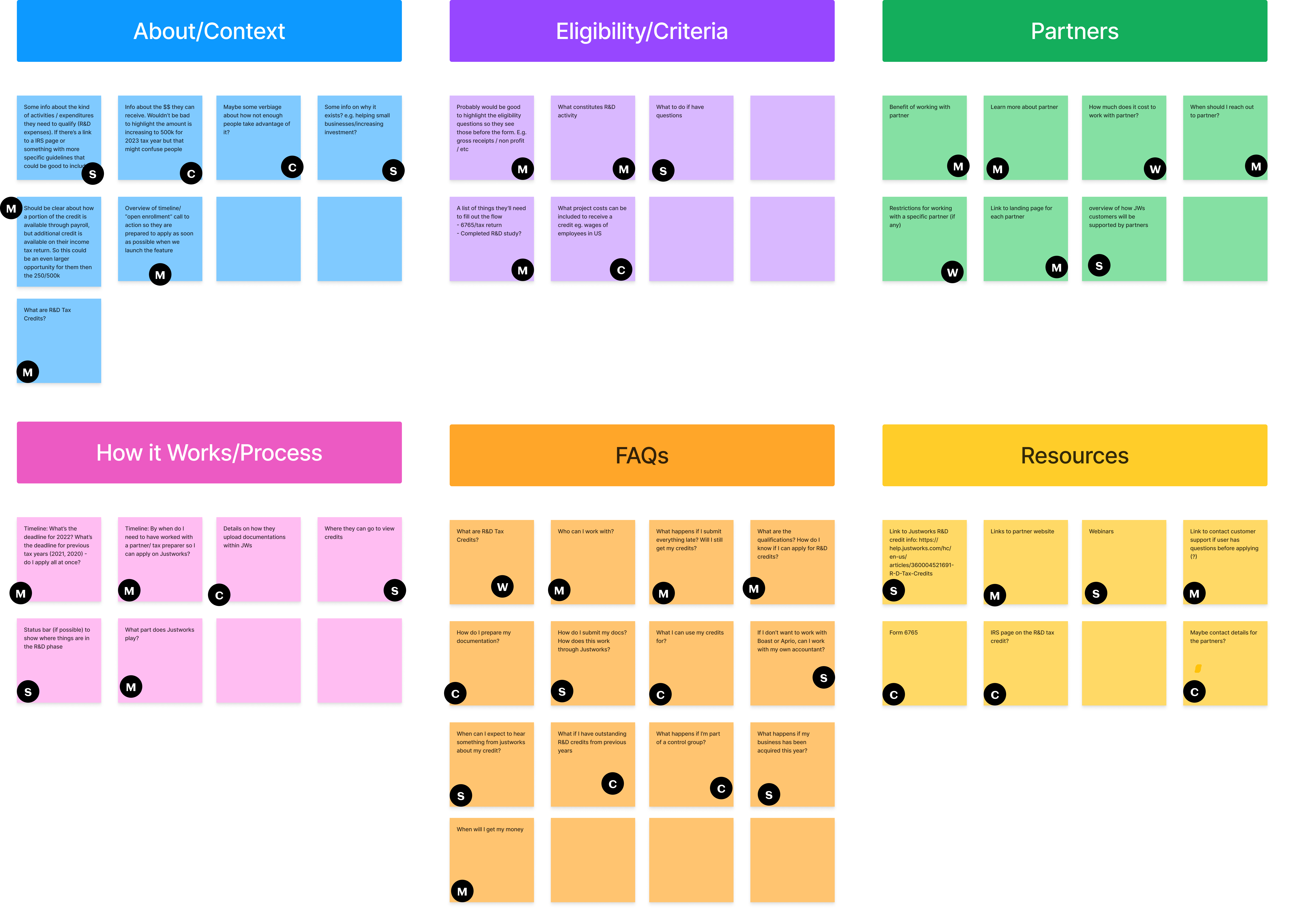
Content to educate customers
Our first milestone was to increase reach to customers by launching an in-app education layer, demystifying R&D tax credits and connecting customers to R&D tax credits.
I kicked things off with a content workshop to group the content into sections and used a MoSCoW framework to understand importance of certain content in relation to each other.
A new R&D tax credits page
Content was tested with internal users who had a low to medium understanding of R&D tax credits and refinements were made before rolling out this page ahead of the completed submission process.
Results
increase in R&D tax credit Help Center views
partner referrals in first 9 months
Submission process (4 weeks)
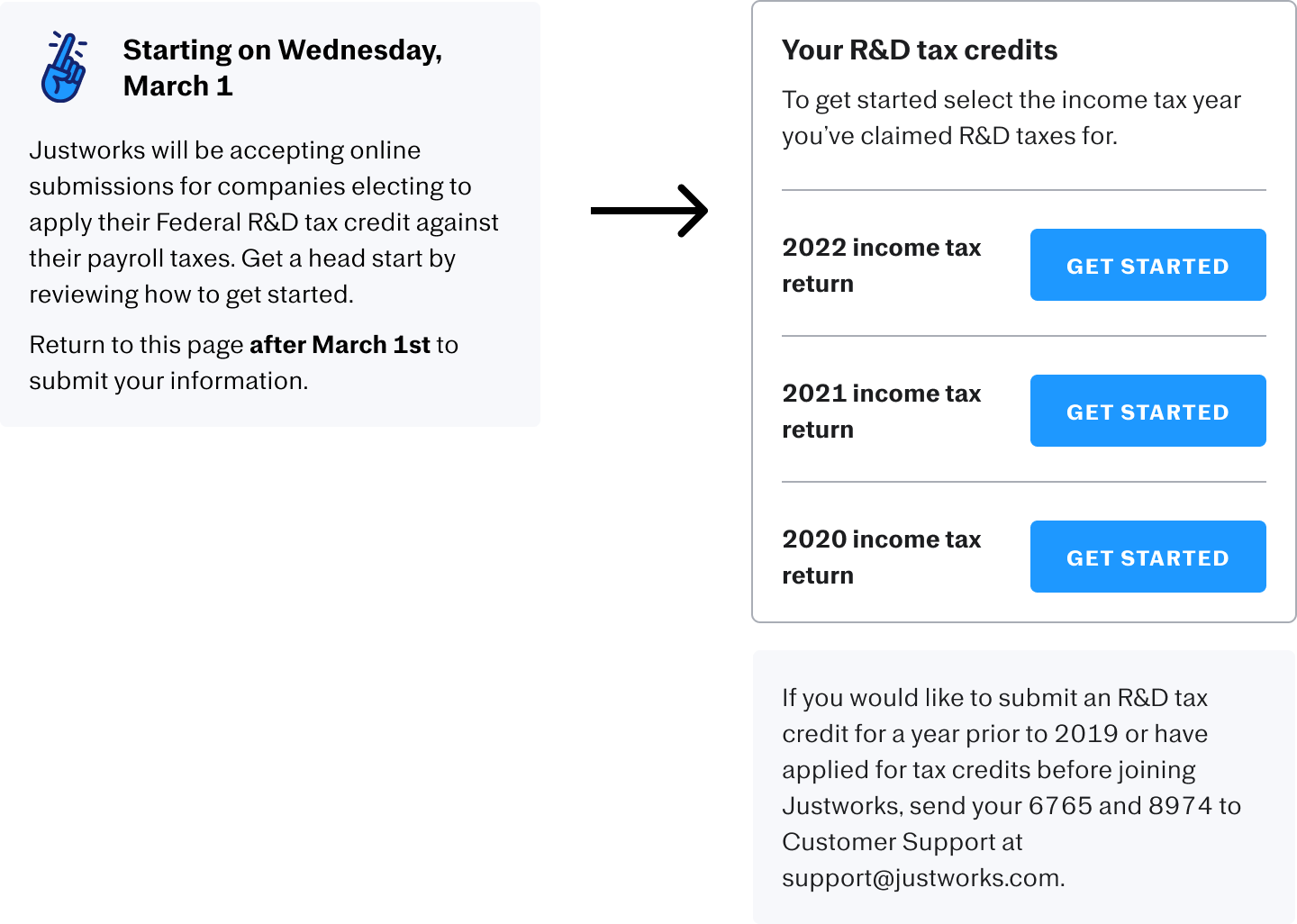
From "It's coming!" to "It's here!"
Upon going live, the details page would switch from coming soon, to a CTA to get started submitting the R&D tax credit. Engineering pushed back on a single entry point due to added complexity to manage different submissions across years, requiring design and engineering to compromise.
Move forward with separate CTAs for each year with a plan to revisit post-launch.
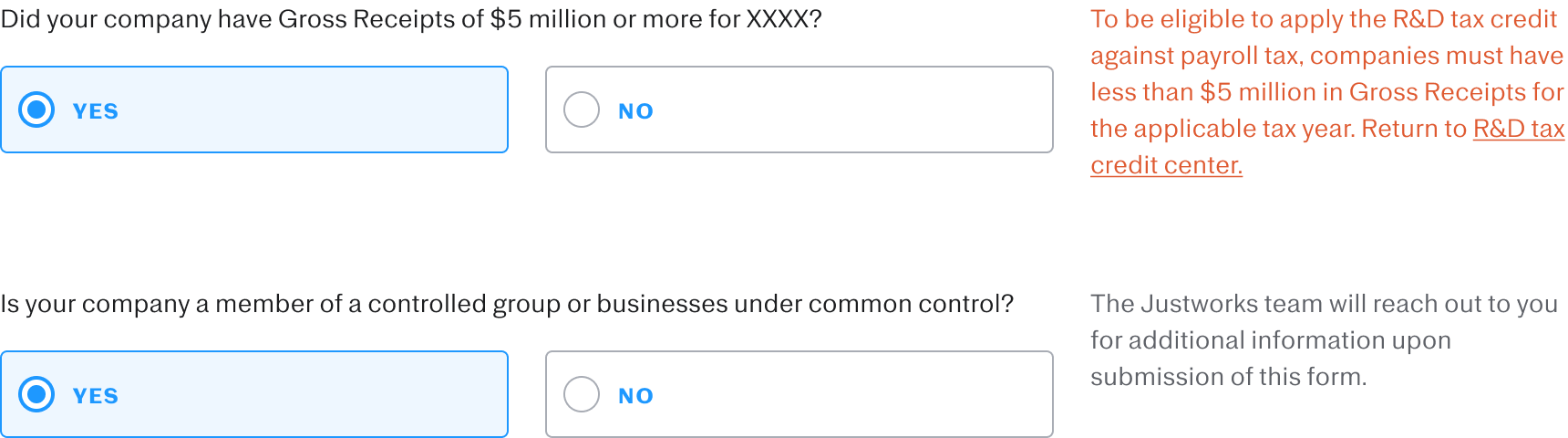
Disqualification vs flag
I partnered with Client Tax Services to align on what information needs to be collected or confirmed during the submission flow. Together, we mapped the validation parameters to intercept ineligibility before submission.
Some answers weren’t black and white and would require follow-up by the Client Tax Services team.
Disqualification
Answering a question a certain way disqualifies the user from continuing through the flow.
Flag
Never disqualifies a customer but is flagged to Client Tax Services for extra review and follow-up.
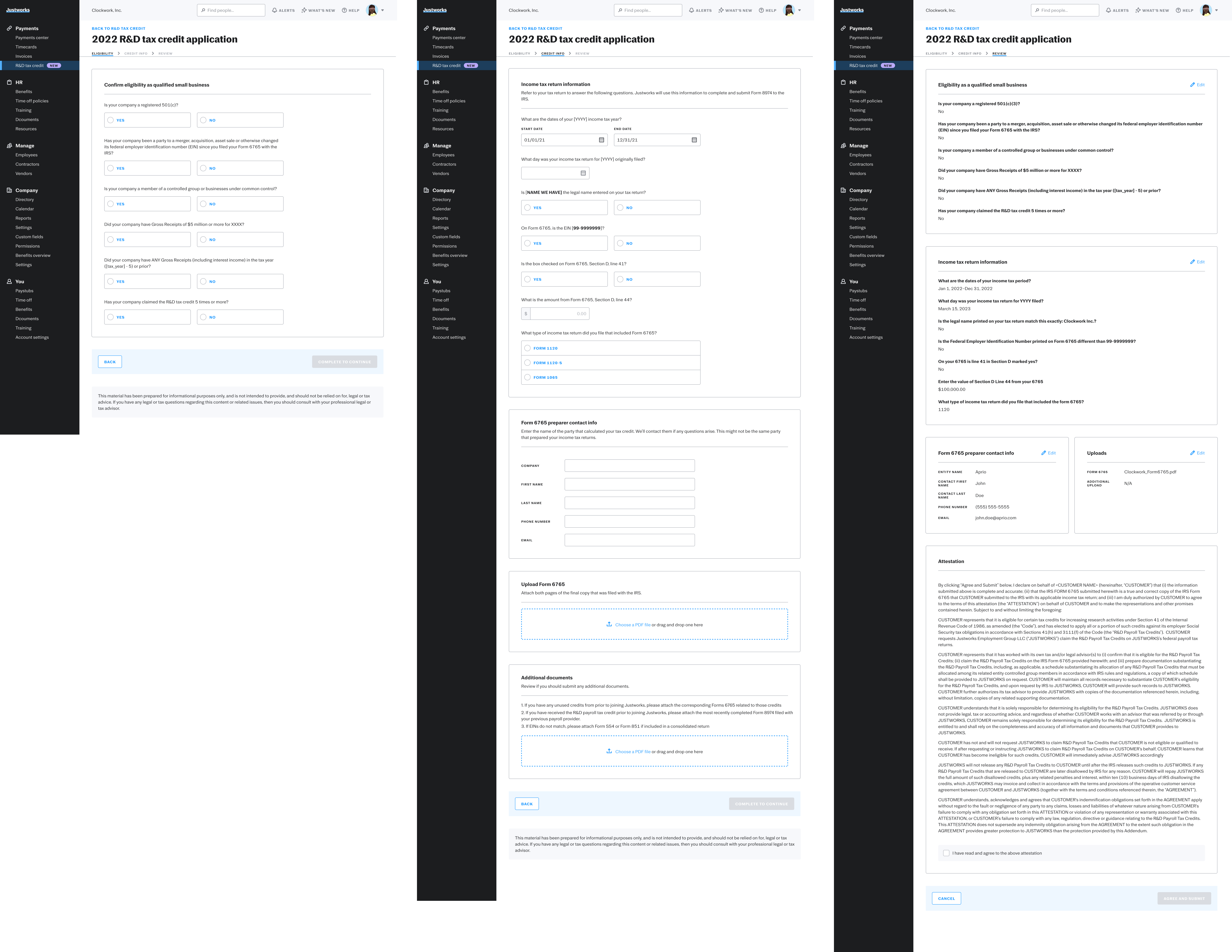
Full submission flow
The new submission flow fully removed the need for CSO to initiate the R&D tax credit process, making it fully self-service for the customer.
Results
of submissions were eligible for R&D tax credits
Tax credit management
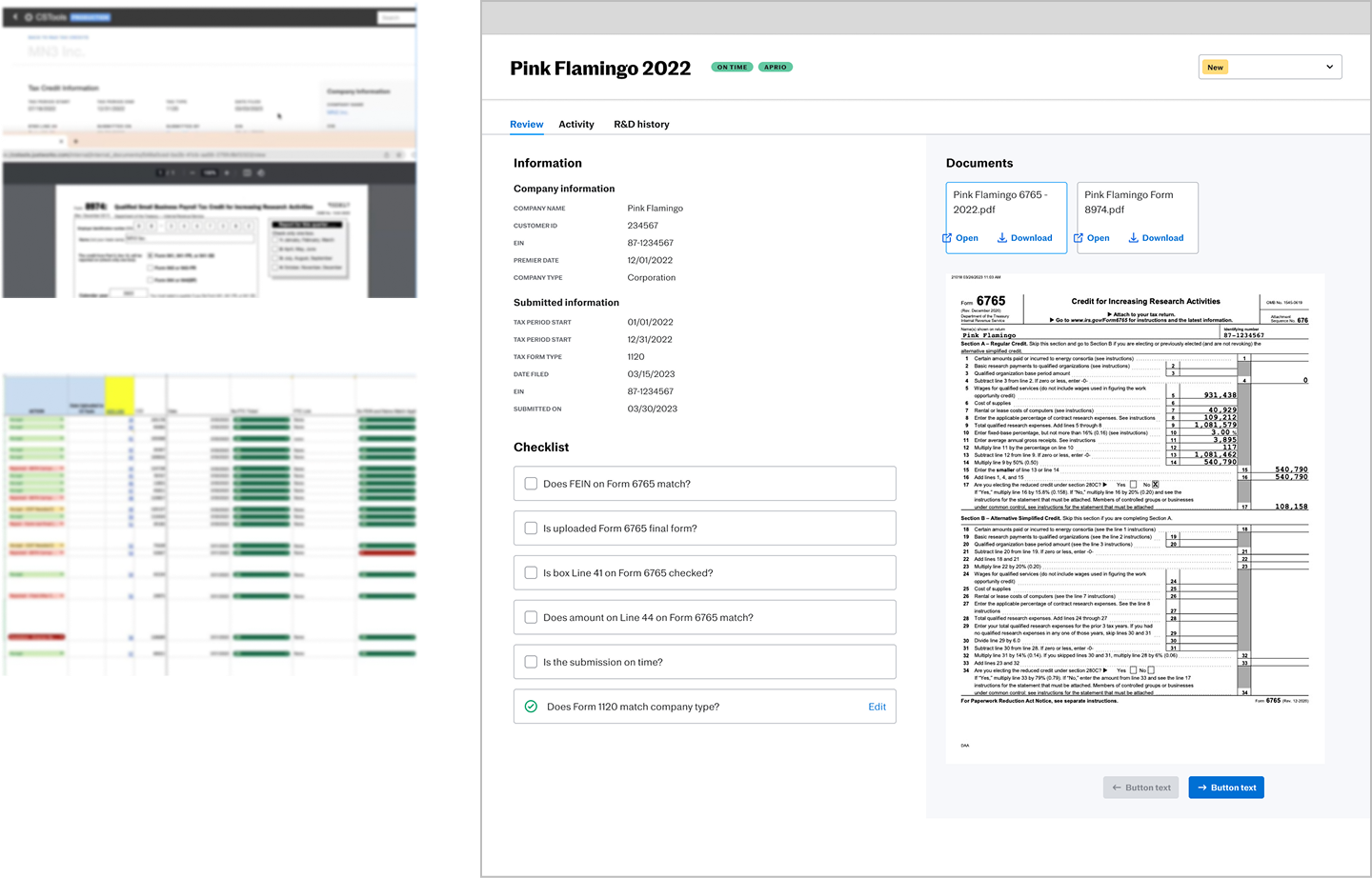
Internal research
Generative research
What is the Client Tax Services team’s process to review R&D tax credit submissions?
Methodologies included auditing artifacts, shadowing the team, and an open card sort.
Tax associates pull data from 4–5 different sources in order to successfully review a single submission
Evaluative research
Do the explored prototypes successfully match the team’s mental model and reduce time to review a submission?
Methodology used was moderated usability testing.
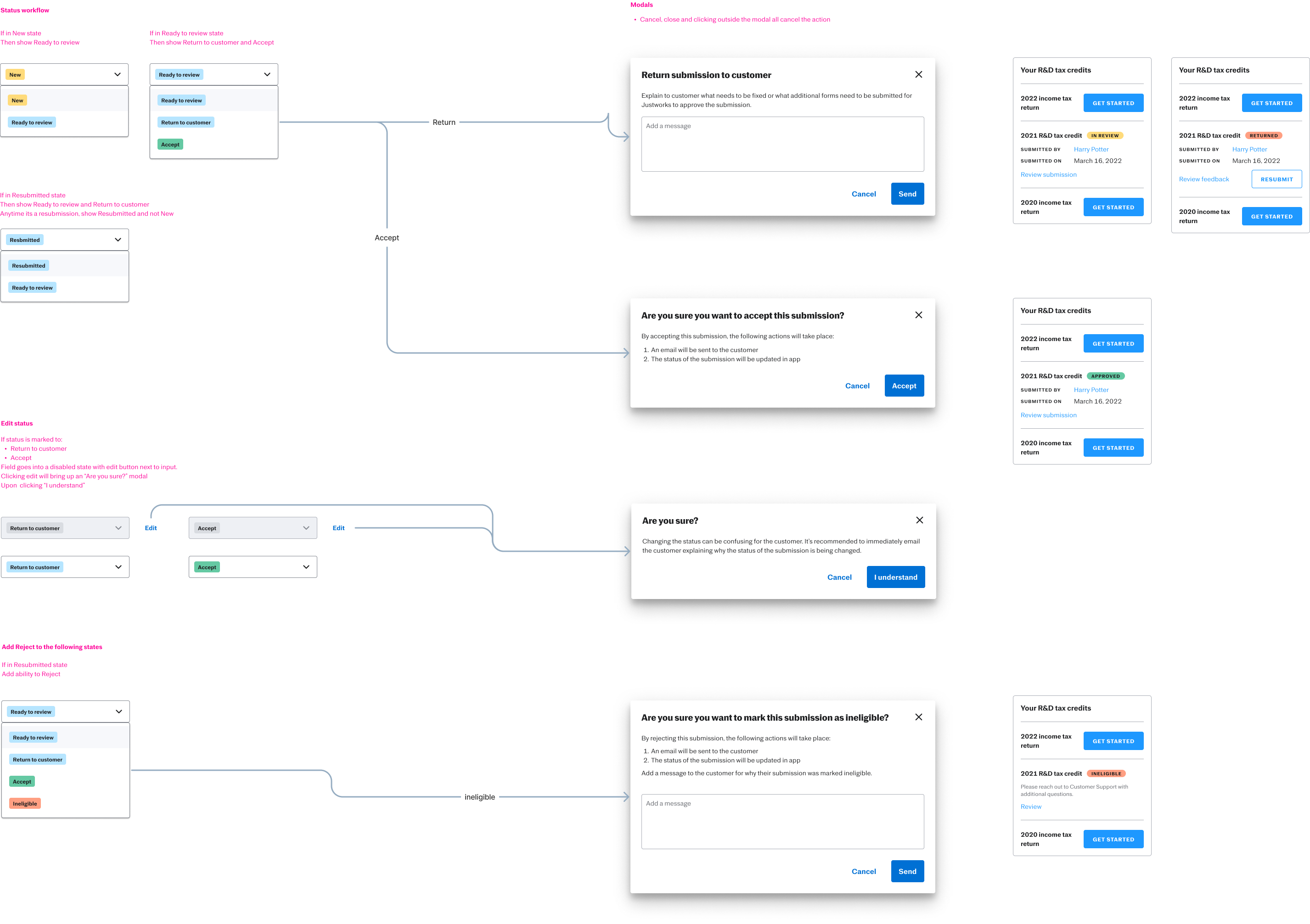
Connecting backstage to frontstage
I collaborated with the Client Tax Services team to develop a new SOP for reviewing R&D tax credit submissions. Managing statuses through a review process led to a development of a new pattern created through a cross-functional design studio I facilitated.
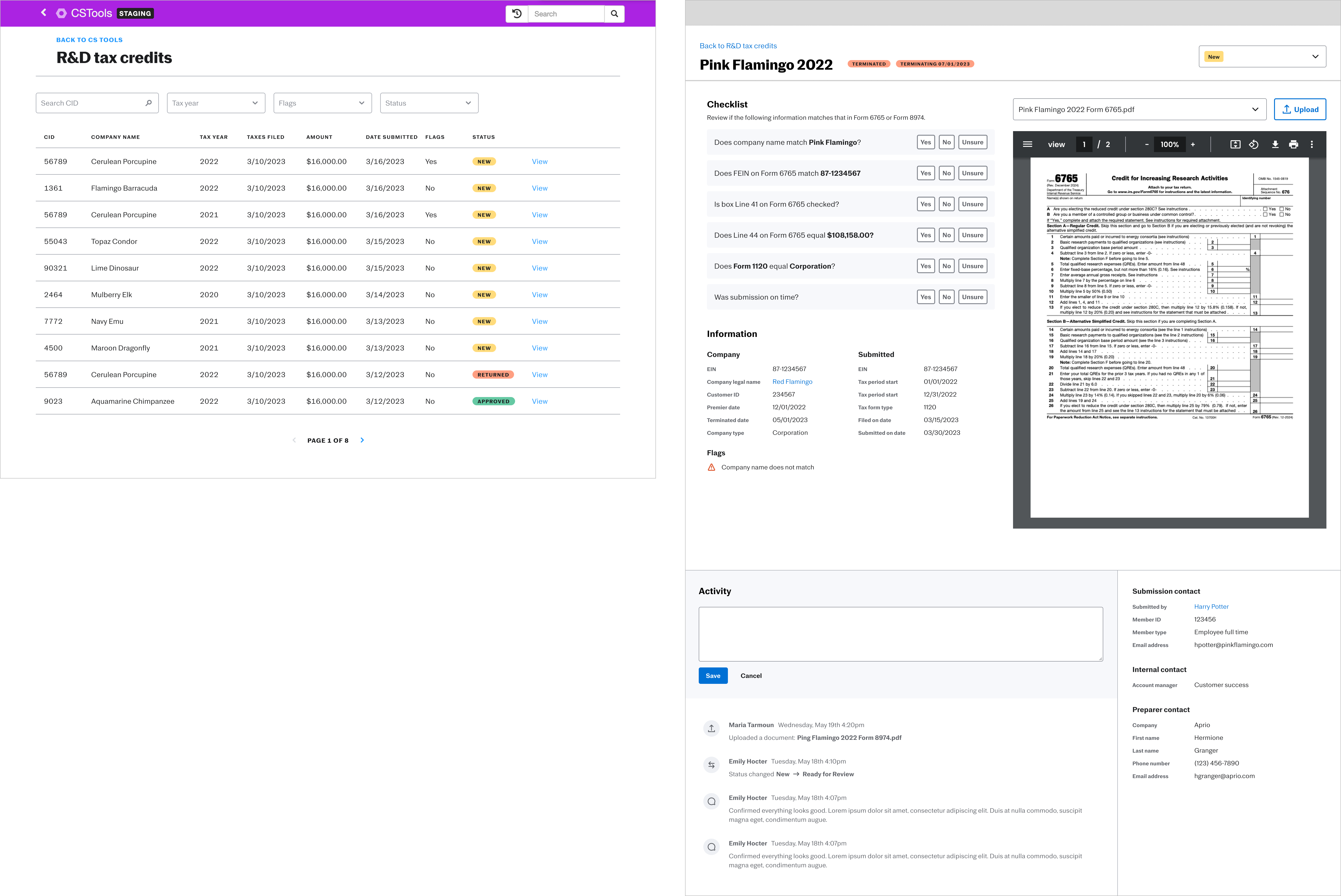
The full service experience
The creation of the internal experience marked the first time a designer had created an internal tool within the Payroll & Tax team.
Results
hours saved by the Client Tax Services team across 700 submissions
Final experience

13 steps, 3 service layers
The new service experience reduced the end-to-end data collection timeline from weeks of email back-and-forth to a self-service session completed in minutes.
Results
- Removed Customer Success from the tax credit management process so they could focus on other work.
- Justworks distributed an average of $89k in credit back to eligible customers.
- Successfully capitalized on a net-new revenue stream by referring 76 companies to R&D tax credit accounting partners in the first three quarters post-launch.
- Reduced review of an “easy” submission from 30 minutes to 10 minutes, estimating 210 hours saved across 700 submissions.
Reflection
- While the workflow diagram helped communicate the process, there was an opportunity to push further into service design.
- Halfway through the project I realized I needed to adjust the review process so legal was always the final reviewer. Previously, content design was trying to make copy changes post legal review.
- I proposed a future phase utilizing OCR and AI/ML data-extraction models to automate the cross-referencing of uploaded forms, paving the way to entirely eliminate manual internal verification as the program scales